
Snake Eyes


I used to be scared of snakes. I can still recall the jolt of terror I felt when I nearly stepped on one barefoot in the woods as a teenager. And when I mowed the lawn, as I pushed along the side of the house, they would stream up the stone foundation in their attempt to escape. My heart was in my mouth, even though I was the one with a deadly machine. I did not wish them harm, and thankfully never hit one, but I was petrified. Which is absurd, considering the snakes of my youth were all garter snakes. It was not a rational fear; it was purely a primitive primate reaction.
I have spent my adulthood unlearning this instinct. When I see a snake, after the initial startle reflex passes, I look through eyes of respect and admiration. I’ve been reprogramming the reaction for thirty years, and I’m happy to report that the visceral response is much reduced, sometimes even non-existent. Living on an old farm with plenty of dry stone walls gives me lots of opportunities to practice, and when I see a snake now, I feel a flash of joy.
As I moved a fallen branch from the trail this weekend, I disturbed my first snake of the season. My reaction was “Wow! Hi, snake! Happy spring!” I feel blessed to experience a true sense of wonder and appreciation in the presence of these graceful creatures, with their unblinking eyes and flickering tongues, rather than recoiling.
In Indian pedagogy, the example of mistaking a rope for a snake is a classic teaching about misperception. It is a brilliant illustration of what happens when we misunderstand something. The rope lying on the ground evokes the exact same response as the snake - perhaps your stomach clenches, your heart races, you yelp. One of the five possible activities of the mind is to perceive something incorrectly, which has to do with how true the mind thinks its interpretation is. It’s not “not knowing,” but rather thinking you know something, and being wrong. The state is called viparyaya.
I keep an eye out for situations when I discover I’ve been in viparyaya - it’s tricky, because you don’t know you’re perceiving something incorrectly until your understanding is corrected. So I consider unearthing a misunderstanding an incredibly powerful teaching tool: my perception felt so right, and now I know it wasn’t. Being aware of that possibility creates a great support for humility, and is a reminder to ask, Am I seeing this correctly?
Viparyaya could just be momentary (Oh! A snake! Oh, not a snake, just a rope!), or could last a long time. I recently experienced an instance of prolonged misperception. My friend and teacher Chris died nearly ten years ago, and for the past few months she has been much on my mind; I’ve been missing her, and wishing I could run some ideas by her. So I have been thinking I should call John, her husband, to whom I haven’t spoken since her memorial service. Her death was tragic and happened at a tumultuous time for me, just days before I left my marriage, and I didn’t rise to the occasion of keeping in touch with John. But I have been under the mistaken impression that he was still alive and well, simply because I’d not heard otherwise.
Thanks to a new friend from my old town, I have learned that John passed away in November from ALS. For the past three months as I’ve been thinking I should call him, that it was just a matter of tracking down his number, he has been dead, after struggling for several years with a terrible disease. I was misunderstanding reality, and am still reorienting to this updated version, which is as shocking as bending down to move a twig and discovering it to be a snake. To be clear, it wasn’t my ignorance of his death that’s the issue, but rather my confident belief that he was still alive in the world.
Yoga asks us to be alert and to clean the lenses of perception with daily practice. My snake encounter and recent sad news have me contemplating the snake in metaphor and reality. In India snakes are simultaneously much-feared (which makes sense when you’re dealing with cobras rather than garter snakes!) and considered sacred. Patanjali, the semi-mythical author of the Yoga Sutras is worshipped as an incarnation of the god Vishnu, and is portrayed with a thousand serpent heads. Vishnu himself, the lord of protection, is said to sleep on a serpent, who provides a perfectly supportive and soft bed for the god. Snakes also represent eternity and rebirth. As legless ground-slitherers, snakes are mysterious and fascinating to us. Instead of eyelids, snakes’ eyes are covered with a clear lens. The appearance of unsleeping vigilance is intimidating, but also evocative of the yogi in deep meditation, filled by awareness.
In the chant that honors Patanjali, we say, “To glorious Ananta, King of Serpents, I offer my deepest gratitude and respect.” As the snakes emerge this spring, may we be blessed with clear vision and discernment, not to mention appropriate awe at the various expressions of life that occupy this planet with us, and honor the eternal cycling of birth and death that we are all a part of.
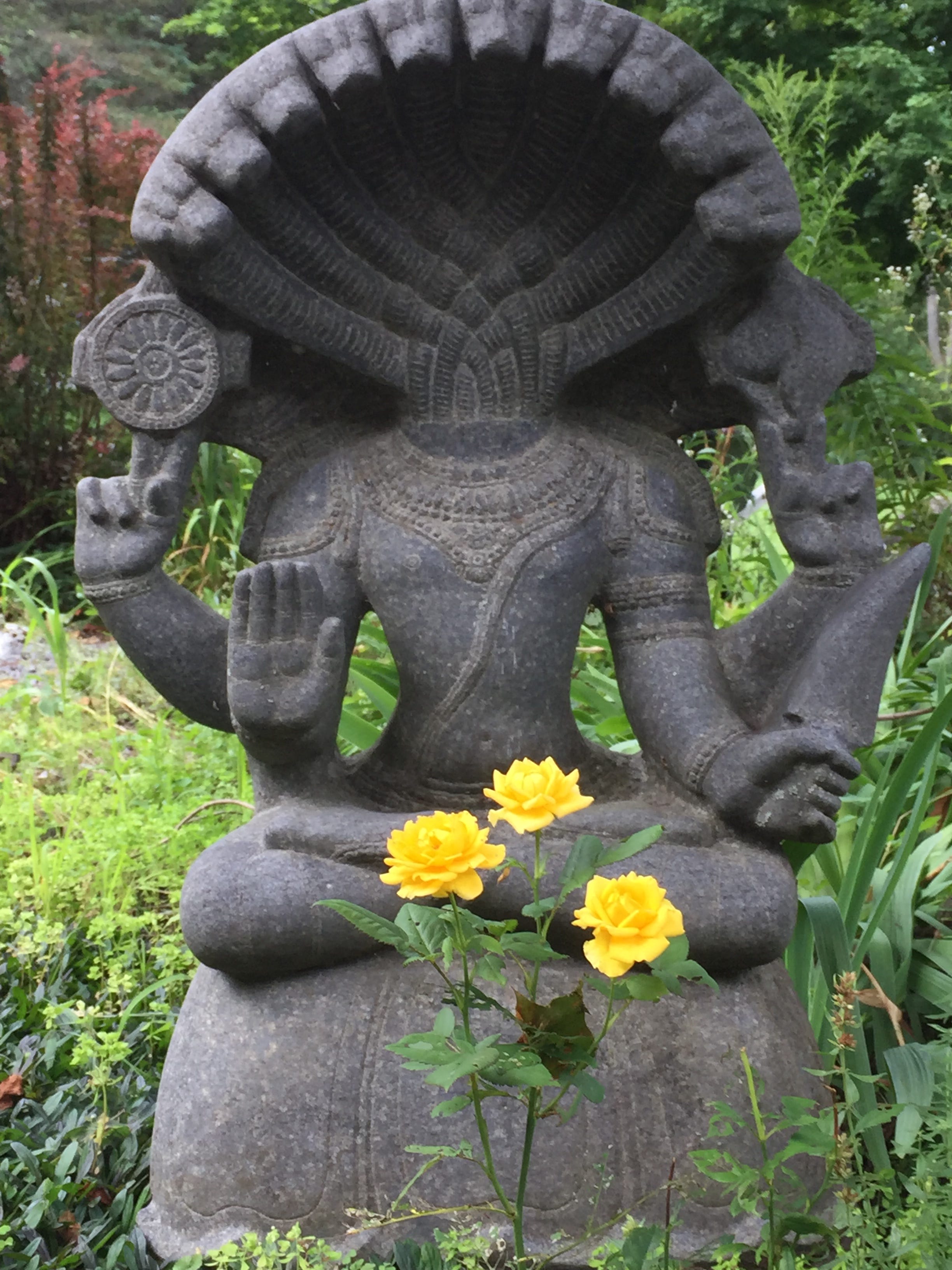
Statue of Patanjali, photo by Kerry Koen