
What To Do With The Body

Dr. Doshi taught the Bhagavad Gita class at my first yoga teacher training. He was about 85, barely bigger than me, and probably the closest thing to a saint I’ve ever known. He was a devotee of Swami Sivananda and had participated in Gandhi’s Satyagraha movement. He spoke about his mortality in a simple and matter-of-fact way, observing that his body was decaying and that before long, he would leave it behind. However, in the meantime, he did ten rounds of sun salutations everyday, washed his own dishes after each meal, laundered his plain white cotton dhoti kurta in the community sink, and guided a bunch of clueless Western students through the great religious text of India. He demonstrated the possibility of taking care of the body and using it as a tool of service, without being attached to it.
In response to last week’s essay, a friend sent me a picture of his Anatomical Gift card, which reads, “It is my wish upon my death, shall I meet the program criteria, that my body be donated to the Anatomical Gift Program… to be used for medical advancements and education.” This donation takes the yoga teaching “I am not this body” to a logical conclusion. Ancient Tibetan monks used to meditate in charnel grounds to confront the reality of their temporary physical existence. Imagining a group of medical students scrutinizing and dissecting one’s corpse might have a similar effect.
Sky burial, the Tibetan tradition of leaving a body in the open as fodder for scavengers is illegal in the US, but we do have plenty of other choices. In some states you can opt to be buried in your backyard, though legal hoops must be jumped through. Green burial is possible, but strangely, less standard than having bodily fluids pumped out and replaced with formaldehyde and being buried in a concrete vault. You can be cremated, which leaves a convenient packet of ashes, but also a big carbon footprint. Composting the body is a planet-friendly trend, or you could choose aquamation, an interesting way to be reduced to a pile of ash. On some level, it seems absurd to have a preference, but I have to admit I do - put me in a hole with as little else as possible and let me take my slow time to fertilize some nearby tree. However, direct burial sounds a lot less attractive when I contemplate the mass graves that some people end up in. I’m still working on “I am not this body.” Perhaps I can evolve to the medical donation alternative.
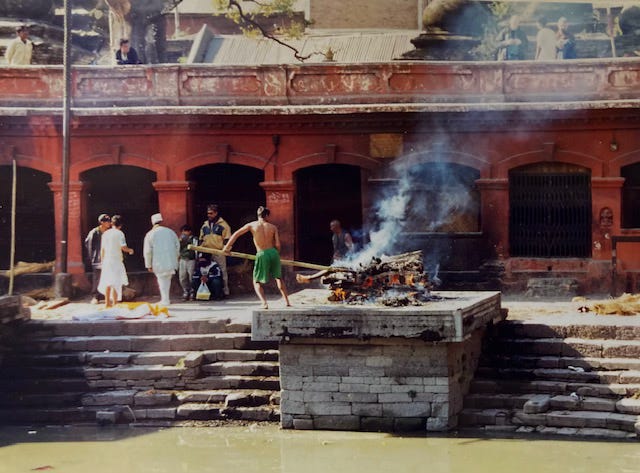
In Nepal, we sat for hours by the burning ghats, transfixed by the sight of burning bodies. A profound meditation indeed to watch an actual human go up in smoke, to see the attendant push a leg more firmly into the fire, to smell charred flesh - an experience seared into my mind.
I recently heard that an old friend makes a practice of clearing dead animals - so bluntly called roadkill - off the road and saying a prayer over the bodies. As I drive past a bloated corpse on the highway, I say a silent apology to the creature that not only met a violent end, but also suffers the indignity of rotting away on the pavement, at least until the scavengers take over. This feels like a koan. Every sentient being has a sacred existence and deserves to have their body treated with respect, and also, the body is only a temporary container, so why do we fuss about its resting place so much?
I imagine Dr. Doshi is dead by now, but he is still teaching me: take care of the body you’re living in, but it’s only a body, so be prepared to give it up some day. And meditating on its end is not an exercise in morbidity, but rather an attempt to understand who it is that inhabits this future corpse.